What Higher Ed MarComm Leaders Are Reading This Summer

Updated: Jul 6
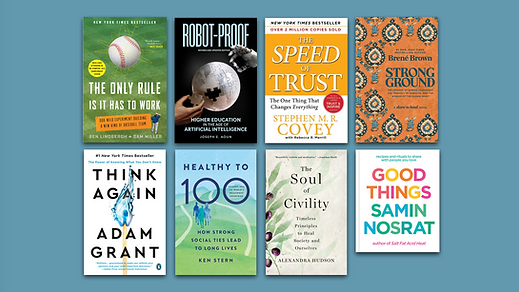
Every summer, I enjoy comparing notes on what smart people are reading and what their book choices reveal about the questions they’re wrestling with at a particular moment. This year, I invited a handful of marketing and communications leaders from colleges and universities across Indiana to share a book recommendation.
Collectively, these selections reflect a set of themes that feel especially relevant: trust, adaptability, community, belonging, civility, healthy aging, and the future of learning. Some leaders shared a brief recommendation; others offered more personal reflections.
Many thanks to Jonathan Purvis (Butler University), Kelly Hiller (Purdue University), Santhana Naidu (Rose-Hulman Institute of Technology), Kathie Fleck (Ivy Tech Community College), and Jim Amidon (Wabash College) for sharing the books and ideas that have captured their attention.
Rob Zinkan, Founder and Principal, Navigate Gray
The Only Rule Is It Has to Work: Our Wild Experiment Building a New Kind of Baseball Team by Ben Lindbergh and Sam Miller
My recent nostalgia about a few summers three decades ago doing radio play-by-play for an independent minor league baseball team led me to this book. The authors, a pair of baseball writers, chronicle their 2015 season leading baseball operations for the Sonoma Stompers, an independent professional team, as they put advanced analytics (sabermetrics) to the test.
On the surface, it may sound like a minor league version of Moneyball, which the book references in one of my favorite lines: “If the A’s were a collection of misfit toys, then we’ll be building a team out of toys that got recalled because they were choke hazards.”
While it’s an entertaining read with its baseball backdrop and colorful clubhouse stories, at its core, it’s a book about change leadership. Do Lindbergh and Miller, the analytics-minded outsiders, have the courage to act? How do they get players and coaches to embrace unconventional approaches, even when the analytics support them? Ultimately, the greatest dividends come from their relational work — investing time, building trust, and demonstrating that they’re working just as hard as everyone else. It’s a fascinating story about the human dynamics of change.
Bonus Pick: Robot-Proof: Higher Education in the Age of Artificial Intelligence (Revised and Updated Edition) by Joseph E. Aoun
The cabinet of a client institution is reading this book together, which prompted me to pick it up as well. With AI accelerating change at what can feel like a daily pace, it’s helpful to zoom out and consider some larger questions: What is the role of higher education in an AI-enabled future, and what kind of model will best support that mission? (It’s also why I'm looking forward to Paul LeBlanc’s forthcoming book, Reclaiming Purpose: The University in an AI World.)
Aoun makes a compelling case that lifelong learning should become the default approach to education as continuous upskilling and reskilling become increasingly necessary.
Perhaps that idea resonated as I find myself thinking about the future careers of my own children (currently spanning high school, college, and first professional jobs) and what learning for life may look like for them. That possibility has interesting implications for higher ed. For example, what does it mean to be an alum, and how might the role of institutional advancement evolve?
Jonathan Purvis, Vice President for University Advancement and Marketing, Butler University
The Speed of Trust by Stephen M.R. Covey
My go-to book recommendation any time of the year is The Speed of Trust. Covey convincingly makes the case that trust is THE foundation for anything great — personal relationships, business success, societal progress, international relations…you name it. And without trust, nothing great is possible.
Our society is more fragmented than ever, and the unprecedented pace of technological change threatens to upend the very fabric of our culture. The resilience needed in this moment can only be summoned from a strong foundation of trust. That makes Covey mandatory reading for anyone interested in contributing to a viable and vibrant future.
Kelly Hiller, Chief Marketing Officer, Purdue University
Strong Ground: The Lessons of Daring Leadership, the Tenacity of Paradox, and the Wisdom of the Human Spirit by Brené Brown
I chose Strong Ground by Brené Brown as a chance to pause and take a more honest look at my leadership approach. As our team and organization continue to evolve, I wanted to revisit how I show up for others, especially in moments that require clarity, accountability, and trust, and use this reading to strengthen the foundation I build with both my team and my peers.
Santhana Naidu, Vice President for Communications and Marketing, Rose-Hulman Institute of Technology
Think Again: The Power of Knowing What You Don’t Know by Adam Grant
I recommend reading Adam Grant’s Think Again. I’ve read it before and am revisiting it now, especially given everything happening with higher ed, AI, and the rapid pace of change across nearly every industry.
The book is about intellectual flexibility and the ability to challenge assumptions, rethink old models, and adapt. In higher ed, marketing, and leadership, I feel that we are entering a period where long-held practices around communication, branding, and learning are being disrupted. Adam Grant makes a compelling case that effective leaders are the ones who are willing to stay curious, evolve their thinking, embrace unlearning, and create cultures where questioning is encouraged.
Revisiting it now feels particularly relevant because of the current environment’s demands for leaders to be adaptable and the need to rethink how we approach the future.
Kathie Fleck, Vice President for Marketing and Communications, Ivy Tech Community College
My dad turned 86 this spring, and I was looking for a gift that was positive and forward looking. My mom passed away unexpectedly, and I saw my dad’s world shrink. I argued with him that social isolation was bad for his health...he would nod in agreement and then ignore me. So, when I heard an NPR interview with author Ken Stern talking about this book, I knew it was exactly what he needed.
Stern takes on the popular wisdom that balanced eating, exercise and proactive health care alone are the keys to longevity. Instead, he posits that successful aging depends more on the strength of social connections.
Analyzing the habits of older individuals living in countries with high life expectancy like Singapore, Japan, South Korea, Italy, and Spain, Stern finds intergenerational connectedness, a sense of purpose, and respect for older individuals have a stronger impact on health than previously realized. Research from widely varied and reputable sources all over the world supports the case that humans are “social creatures, biologically wired for social connection and common purpose.” We need social connection to thrive, not merely survive.
What caught my attention was his distinction between life expectancy and healthy life expectancy. Life expectancy alone in the U.S. is 74. This is six years less than less developed countries. However, when considering how healthy individuals are during those 74 years, research shows older U.S. residents live 12.5 of those years in poor health.
Bottom line — if we want to live longer, experience less chronic disease, recover faster from illness, and maintain better cognitive health in the second half of life, both individuals and communities need to flip our current practices and invest 90% in social health and 10% in physical health.
Here’s the result of my own research project: my dad has gone back to church, accepted an invitation to play in a Friday afternoon Euchre league, and even took over the social secretary job my mom held with a group of older colleagues. Not earth-shattering change, but one step at a time.
Jim Amidon, Chief of Staff and Director of Strategic Communications, Wabash College
The Soul of Civility: Timeless Principles to Heal Society and Ourselves by Alexandra “Lexi” Hudson
Her book started a conversation and the conversations have led to workshops and the workshops have led to retreats. She’s pulling together civic leaders, teachers, parents, businesspeople to read her book and have intense, intimate conversations about reclaiming civility. She cohosted with Mitch Daniels a retreat in Carmel last year that was incredibly powerful.
The LA Times called her book “utopian” and to a degree, it is. The lack of civility didn’t happen overnight and creating a more tolerant society can’t be done in 100 weekend retreats. But it does make you think about yourself and your own behaviors and attitudes in a way that is soulful. One reviewer said, “This truly is an exceptional, bordering on transcendental, examination of the history and nature of civility, with plenty of real-world applications that are sorely needed — and truly challenging for even the most committed of us. This is one of those books that is going to challenge you to be better in ways that few outside the overtly religious texts manage to do, and it is one that is largely going to leave you with a smile even as it calls you out.” I agree with this take and have been in discussion with Lexi about coming to Wabash in the coming school year to work with our students on how they can reclaim civility.
I say Lexi’s book one is “unrelated to food,” but she wrote an incredible blog, “When the Guest Becomes the Gift” (December 2025), on her website that pulls her ideas of civility around a dinner table when she cooks for the chefs who cook for us. The blog is behind a paywall, but here’s a snippet:
“We talk about hospitality as if it flows in one direction, host to guest. But the relationship is reciprocal. In ancient Greek, xenos referred to both stranger and guest. The border between giving and receiving was porous. A guest could elevate a host or make their work harder. A host could uplift a guest or do the opposite. Hospitality and hostility share a linguistic root for a reason. Encounters can nourish or drain. They can expand us or close us down.”
Bonus Pick: Good Things: Recipes and Rituals to Share with People You Love by Samin Nosrat
I’m someone who loves to cook and entertain friends, yet I didn’t think I needed this book, which IS very much a cookbook. Nonetheless, my wife, Chris, got it for me for Christmas. I was aware it was coming out last fall but paid little interest until the New York Times ran an excerpt on September 15, 2025 titled, “Samin Nosrat Gathers Friends for Dinner Every Week. Here’s How You Can, Too.”
After moving to a new town and battling through depression, Samin and friends started a weekly dinner tradition. “Four years in, this ritual and the community that sustains it are at the heart of my life. These friends have taught me what it means to belong. And I’ve finally found the sense of meaning — in cooking and in life — that I’ve sought for so long. It brings me indescribable joy to share food with my Monday dinner family.”
The excerpt and accompanying recipes landed at a good time. Even with the holidays approaching, Chris and I began to feel more and more distant from our friends and community. Politics, divisiveness, government overreach, war, and economic uncertainty dominated headlines, and the holidays allowed for some connection, but not like we enjoy at our outdoor summer dinner parties. I was depressed and missed my friends. This book arrived wrapped under the Christmas tree and inspired me to try to replicate Samin’s weekly dinner party experience — with friends and community at the heart of the event, not necessarily the food. I sent our closest friends the NYT excerpt, and we have started our own version building happiness and strengthening community one meal at a time.
